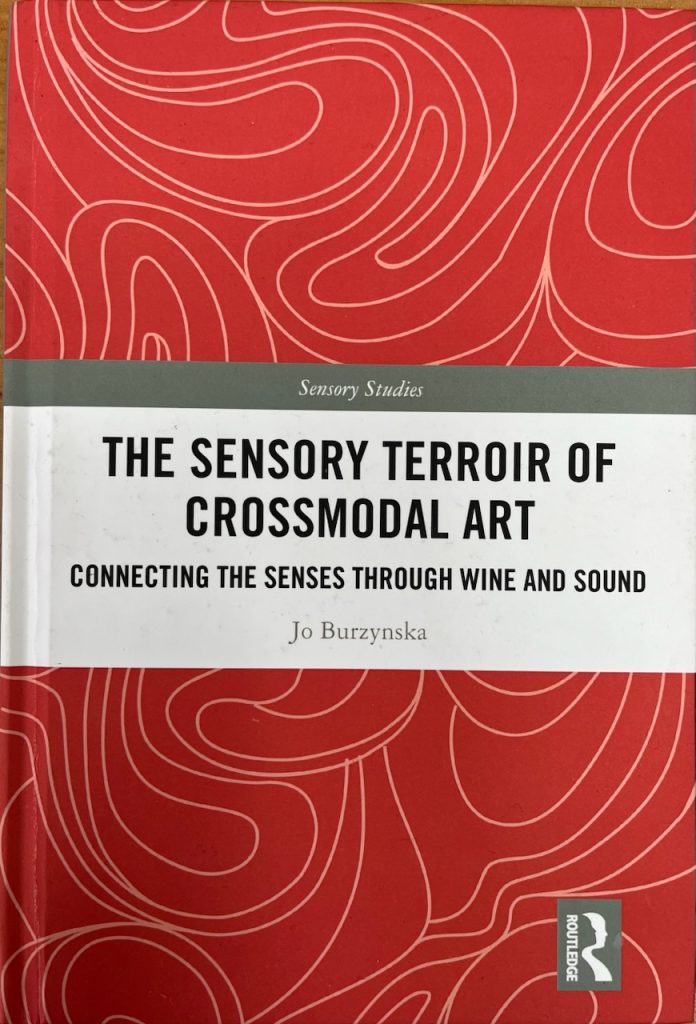
Introduction to a book by Jo Burzynska ‘The Sensory Terroir of Crossmodal Art. Connecting the senses through wine and sound’.
https://joburzynska.com/sensory-terroir-the-book/
Jo Burzynska is a British-New Zealand multidisciplinary researcher, artist and writer working at the intersection of art and science. In her book she introduces crossmodal art as a category of creative practice merging multiple senses and also as a perceptual training that will open new ways of experiencing the world.
This book may be of interest to readers of the JTTS magazine as in it Burzynska outlines her process and methods for creating crossmodal art. She is of the opinion that synaesthetic art is too individually subjective and that audiences would more readily engage with disciplined crossmodal art because it would be more understandable than synaesthetic art.
She makes a case for separation of ‘crossmodal’ art which utilises widely shared correspondences, from synaesthetic art ‘shaped by the individual sensory couplings in synaesthesia’; and calls for awareness of ‘moderating’ one’s art work which will connect with a wider public. She says ‘synaesthesia does not necessarily provide a universal language for translating between senses’. Burzynska compares the intense and often idiosyncratic experiences of a synaesthetic artist creating a sensory experience with that of a non-synaethetic artist.
The Sensory Terroir is an excellent discourse on the expansion of creativity and art. Burzynska’s art practice is deeply informed through both her experience and experiments, using focused attention and contemplative practice for her method of creating her crossmodal art. She illustrates this with impressive fieldwork and creative research, interviews with wine growers and deep sensorial engagement with vineyards and terroirs in Italy, Britain, Australia, France and NZ
Burzynska proposes that its time to replace the term ‘synaesthetic art’ by updating it to ‘crossmodal’ art. In his 1999 paper on Synaesthetic Art https://scispace.com/pdf/synesthetic-art-an-imaginary-number-17lrz8mlki.pdf Paul Hertz also discusses the nomenclature ‘Persons, not artworks, are synesthetic. Ultimately there is no such thing as synesthetic art – but that has not stopped anyone from trying to create it. We use the term “synesthetic art” rather than something more precise such as “crossmodal art” because the idea of correspondences among the senses and their fusion into a whole experience has fueled the imagination of so many artists’. Hertz suggests points of departure for a poetics of multisensory composition. ’The remarkable thing is not that “synesthetic art” turns out to be a chimera, but that it is such a compelling and useful chimera for the production of art’.
It is true that synaesthetic experience is idiosyncratic but that, to me, means that there are multiple synchronising forms, resonances and integrations. No one way is correct.
As an artist urged by correspondences, I consider Burzynska’s argument persuasive. However the intersensory correspondences through which I’m motivated have an integrity that is, to me, a true equivalent. The equivalence has a resonance – for me. I was once asked if my chosen colours for particular sections of an orchestra were too subjective. My understanding is that in art everything is subjective. For example, the colour that I choose when I’m painting is a particular colour. It’s not random because it’s the colour that feels right, not just by itself, but in relationship. It’s in these relationships from these cross-wired webs of metaphors and materials that synaesthetic artists build their language.
I too have mixed feelings about the word synaesthesia. I prefer the term intersensory correspondences. In 2000, the MIT Press Journal, Leonardo, featured a Synesthesia Special Project by Jack Ox and Jacques Mandelbrojt, followed by the Intersenses and New Technologies Symposium in Marseille. The symposium included presentations by Jacques Mandelbrojt, Paul Hetz, Jack Ox’s colour organ for the 21st Century, and the studies by Laboratoire Musique et Informatique de Marseille, MIM, mapping music to colour, and proprioception.
Even when I became familiar with its meaning, I avoided applying the term ‘synaesthesia’ to my own work. As a visual artist, my synaesthetic experiences inform my approach, bringing things together not only in the content within the work but also in its structure and mediums—colour, taste, odour, sound, texture, movement in visual, olfactory, auditory, proprioception, touch, taste, personification.
Burzynska’s investigations explore the infinitely multisensory nature of aesthetics, suggesting its re-conceptualisation, from being marginalised and focused on hierarchies and value judgements, to where artists and shamans expand experience through activating novel ways of using and combining the senses ‘Since being alerted by psychological studies to the existence of these crossmodal correspondences as a shared trait of perception –rather than the idiosyncratic connections of neurological synaesthesia–this fertile field of creative enquiry has opened up far-reaching possibilities for making what I propose to call crossmodal art’.