Patricia Lynne Duffy at Mercer Labs in New York City
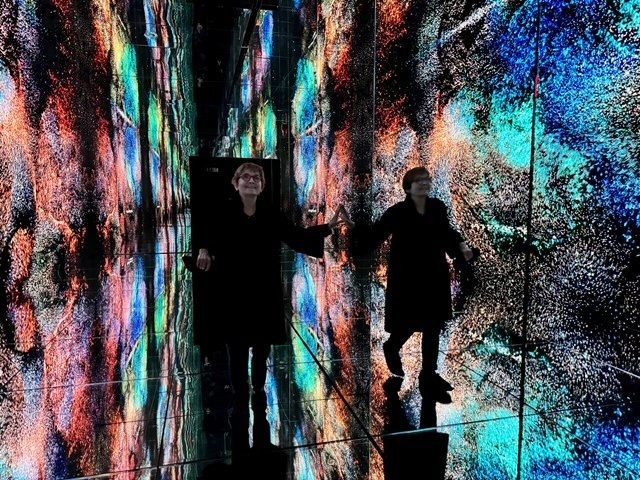
Photo by: Francoise Bouffault
| “You are left to wander and wonder in a world of illusory 2-D and 3-D landscapes of morphing images, sounds, substance, or a fusion of these. A bridge appears up ahead…can you cross it?” |
By Patricia Lynne Duffy
“We’re not in Kansas anymore” said Dorothy in The Wizard of Oz after a tornado blew the family house from her familiar Kansas town to the strange dimension of Oz. It is Dorothy’s famous line that came to mind and that I spoke out loud to an equally wide-eyed “Boomer” also wandering “Limitless”, the exhibition at Mercer Labs Museum of Art and Technology in New York City.
As I crossed the threshold from the Mercer Labs lobby to the exhibition’s “immersive landscapes” of shifting colors, sparkles, sounds, generated by AI, robotics, light and sound merging — familiar everyday reality, as generally experienced in the outer world, was left behind. Here we were walking on the cutting-edge, into the future.
In the Lab exhibitions, visitors are left to wander and wonder in these shifting landscapes, uncertain as to what is illusory 3-D and what is solid. At one point, wanderers cross what appears to be a “bridge” from the first exhibits to the ones ahead. The “bridge” is composed of a transparent floor and walls with shifting images below, to the right, left, and above.
At first, I and my companion (also a “Boomer”) were reluctant to cross the bridge, feeling we might fall through an illusion of two dimensions posing as three. Our first impulse was to turn back from this baffling world to the ‘before-the threshold-lobby-world’ we knew.
It was only when we saw a mother wheeling her three-year-old child in a stroller across the “bridge” that we decided we could brave it too. As we crossed the bridge of shifting illusory realities, my eyes were fixed ahead on the stroller holding the unphased toddler. I could not help thinking of the biblical phrase, “And a little child shall lead us”
The immersive landscapes of “Limitless” have no plaques, no explanatory signs. Some visitors find the absence of narrative frustrating, but to me, it seemed fitting: the viewer is now a lone explorer, a pioneer in an emerging reality; the exhibits seem to herald a new world where the real and the illusory blend, where symbols become solid realities and then morph back into the abstract mysteries.
At one point, you pass through a space of endless falling sparkles all around you; in another, you come upon surreal orchards of cherry trees, that transform into a kaleidoscopic version of themselves, their dense pink blossoms blowing vigorously in a blizzard of petals; in another “landscape”, a blindfolded monkey inexplicably appears and drops into cascades of pink carnations.
The exhibit has many references to blindness, to the many things that escape each of us, to the impenetrable mystery of individual perception. Can a sighted person imagine how a blind person perceives the world?
Also displayed are hyper-real portraits of blind persons by Roy Nachum, the master artist and technician behind Mercer Labs. Nachum invited each blind subject to draw a “self-portrait” over his hyper-real figurative one. In contrast, each of the self-portraits is abstract, its colors and shapes evoking something of the subject’s inner life, self-perception, apprehension of external space.
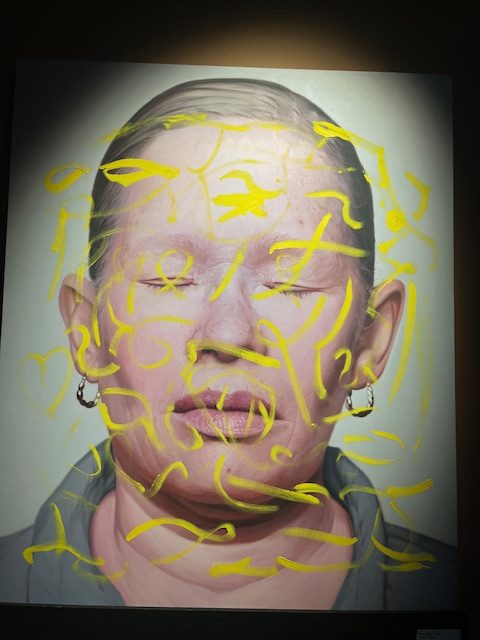
Nachum’s interest in the perceptions of the blind and resulting artwork were inspired by his beloved grandmother, who had gradually lost her sight.
There is reference to Rihanna’s album Ani—which focuses on the theme of blindness both literally and metaphorically. Some exhibits include Braille.
An implied question is: what to make of individual perception? How does the world, filtered through a given individual lens shift and morph in contrast to another? What does each of us miss that others “see” and vice versa? What can each of us learn from an increased awareness of the often very different perceptions of others?
For JTTS readers, the question may arise, what would a synesthete make of all this? These shifting outer landscapes may be reminiscent of aspects of synesthetes’ inner responses to music, to touch, to taste; having similar external images all around you is powerful—after a lifetime of confining such reactions to the private inner world.
In my own case, sounds in the exhibition gave rise to shadowy inner shapes that sometimes echoed or posed a contrast with those in the exhibition.
For synesthetes, the fact of differences in individual perception is an everyday awareness, as their fused together senses provide a dimension of experience not shared by most. The abstract landscapes of “Limitless” may remind synesthetes of aspects of their own inner worlds (e.g., sound-induced shifting colors and textures, etc). Those synesthetic inner worlds may in turn, enhance the experience of this immersive exhibition. Hopefully, it will not lead to sensory overload, but rather to new input to arouse one’s own synesthetic percepts to blend with or add to the world of “Limitless”.
The visitor’s own perceptions are key to affecting and co-creating the reality all around. It is a reminder that any time any of us looks at the world a new, never before-seen world is created. In this emerging new reality, we are indeed not in Dorothy’s “Kansas” anymore.
Hope you can make your way to Mercer Labs in New York City– and cross that threshold. Price of entry is a bit steep, $50. for an adult ticket. However, contrasted with the $200 or $300 (and up!) price tag on many of New York’s Broadway plays, “Limitless” is a bargain and an unmatched eye-opener.
Start your exploration here:
Mercer Labs Museum of Art and Technology
Patricia Lynne Duffy is the author of the now classic, Blue Cats and Chartreuse Kittens:
how synesthetes color their worlds, the first book by a synesthete about synesthesia. An
audio version of the book with research updates, music by synesthete-composers, and
an “Afterword” is recently out. Available from Audible She also contributed a chapter,
“Synesthesia and Literature” to the Oxford Handbook of Synesthesia. See her
website, bluecats.info