
| “…Discovering intersectional identity is like going from one note to an entire symphony; everyone deserves a chance to be more than one thing at a time.”– Emily Barth Isler |
Patricia Lynne Duffy is the interviewer
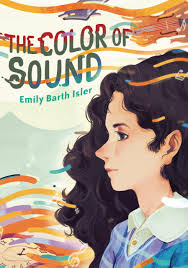
PLD: Your poignant coming-of-age novel, The Color of Sound introduces the reader to 12-year-old Rosie Solomon, a musical prodigy and a music-color synesthete. Rosie can “replay” full symphonies in her head after hearing them only one time—and experience them with vivid colors and textures.
As her days are filled with violin practice and performance competitions, Rosie has little time for a social life, almost no friends, and is lonely. Is the character Rosie based on any real person you know?
EBI: Rosie is a completely fictional character, but parts of her experience are influenced by real people and circumstances.
I was not a child musical prodigy in the way that Rosie is, but I was a professional actor starting at the age of 5. My experiences of living the almost double-life of a kid with adult abilities and responsibilities were some of the seeds of this story. I did play a lot of music as a child, as well, training with the Peabody Children’s Chorus in Baltimore among other vocal groups, plus playing the viola and the harp, and singing professionally onstage. Music was a huge part of my childhood, and it was fun to revisit that for this story.
PLD: Did your own Mom and Dad influence the portrayal of Rosie’s parents?
EBI: My parents were not like Rosie’s are in the book, but I knew other actor and musician kids with parents who put a tremendous amount of pressure on them to perform. All of us read about parents like that when young stars grow up and reflect back in memoirs.
My parents were conscious of trying to ensure that I had a well-rounded life, so in imagining Rosie and her parents, I asked, “what would it be like to NOT have that priority in mind?” and took the story from there.
PLD: Are you, yourself, a synesthete? Do you identify as “neurodivergent” in any way?
EBI: I identify as VERY neurodivergent! I am a synesthete– I have a few types of synesthesia. I also have ‘obsessive compulsive disorder’ and ‘generalized anxiety disorder’. A lot clicked into place for me once I viewed those as all being under the same umbrella. It is helpful to learn how they all play together.
I don’t have the exact kinds of synesthesia that Rosie, the main character in the book, has, and that was on purpose. First and foremost, I chose for her the kinds of synesthesia that I knew would serve the story best; I thought that Rosie’s hearing color and seeing music would be a wonderfully descriptive way to explain to the readers what it’s like inside Rosie’s mind.
PLD: What kind of synesthesia do you experience?
EBI: I have more of the ordinal-linguistic personification, grapheme-color, stimulus-dichotomy, and concept-shape forms of synesthesia.
I wanted to distance myself from Rosie so that the novel was clearly not an autobiography; I wanted to make sure the book wasn’t about me! The story is fiction, even though I do draw a lot from my own life and experiences. It helped me to give Rosie a different variety of synesthetic experience, one that served the story best.
PLD: To explore who she is beyond playing and performing, Rosie gives up the violin – to her parents’ dismay. She spends a transformative summer at her grandparents’ rural Connecticut home, where she finds a shed — which turns out to be a “portal” to another dimension! In it, Rosie regularly encounters Shanna, who turns out to be her own mother at Rosie’s age, 12.
As the book’s author, how did this magical aspect of the story come to you?
EBI: This part of the book is very much based on my own role as a parent! I have two wonderful, creative kids, and at various times, I find myself saying to them, “I know how you feel– I went through something like that when I was your age!” and wishing I could travel back in time to prove it. That was the first seed of the time-bending aspect of the story. I realized that as much as I would love to meet my kids as myself at their age, I would also love to know what my parents were like at my age, and how we all forget that those who raise us were once kids, too.
PLD: In your own life, have you ever felt you needed to hide certain aspects of yourself—for fear such traits might alienate others? Or have you ever known anyone who felt they had to do this?
EBI: I was raised in a time and culture where talking about my neurodivergence was very much frowned upon. We didn’t even use that word yet. My anxiety and OCD were like a dirty secret I was supposed to hide from people, and I didn’t even know I had synesthesia at all. I spent years and years masking and pretending I wasn’t constantly struggling with my busy brain.
PLD: How have readers reacted to The Color of Sound? What have you learned about yourself from writing it?
EBI: Every time I talk to a group of kids about writing, often at school visits, at least one person comes up to me afterwards to say that they’re also neurodivergent Seeing someone who is considered successful and creative talk about their own neurodiverse experience has been meaningful to them. That is why I do this– I didn’t realize how much of my writing was influenced by the way my brain works at first! And now I want to tell everyone!
I’m learning so much about myself as I go through this process, and if anyone else around me can benefit from my talking about it, that is the greatest gift. I always hope that some kid out there is reading my books now and realizing that the way their brain works isn’t “weird” or “bad,” but is maybe different and interesting, and that they’re not alone! Or maybe their brain doesn’t work like that, but they know– and develop greater empathy for someone in their life who is neurodivergent. Books are bridges of empathy.
PLD: In the novel, Rosie’s Mom feels alternately proud of and burdened by her daughter’s musical gift. She is concerned by Rosie’s unusual synesthetic and memory traits and warns her daughter to hide these. As she says, “Just don’t tell anyone, OK? … Some things other people can’t understand, so we don’t share them.”
EBI: I think Rosie’s mom had that generational trauma and messaging in mind when she told Rosie not to tell people things they couldn’t understand. Sometimes those very things can be dangerous, and other humans can be cruel. But living an authentic life is so very crucial to a satisfying existence, and the push and pull between these two needs is one I think most readers can relate to in one way or another!
I was interested in how this felt like an intersection of my Jewish identity with my neurodiverse identity: the overall theme of what we choose to hide versus what we share with the world.
PLD: The Color of Sound has a powerful theme of learning to appreciate what makes each of us unique, while also understanding the cultural ties that bind us to others: to family, history, and community. In a sense, Rosie must go beyond the “one-note” notion of herself as a synesthetic musical prodigy to find a fuller sense of who she is. Do we sometimes need to get beyond ourselves to find ourselves?
EBI: Absolutely! I love this question– it’s exactly what I hoped readers would get from the book! We are all given ideas of who and what we are from birth, from things like our assigned gender to societally-imposed concepts of the things we should prefer or want. This can be as simple as girls wearing pink, or as complex as a musical prodigy wanting to explore a talent other than music. It’s hard to look outside the messages we’re given — like diet culture or racist teachings or political misinformation. It’s the ocean we’re swimming in.
I related to this idea not just as a synesthete or a Jewish person, but as someone who is currently both a mother and a daughter, both a writer and a reader, trying to see the world from all available angles and enjoy the views!
Letting Rosie discover her intersectional identity is like allowing her to go from being one note to an entire symphony, and everyone deserves a chance to be more than one thing at a time.
PLD: Is there anything else you would like to say about The Color of Sound and its characters?
EBI: I’m so grateful that many synesthetes have related to this book. I know that readers who don’t have synesthesia might be discovering it for the first time, so I’m honored to present the concept to a broader audience.
Some readers might realize they have synesthesia, and that’s incredibly exciting to me. I didn’t realize I had synesthesia until I was in my early 30s. I had no point of reference because I’ve only been inside my own brain. We don’t know how other people are experiencing the world, so we often assume they are experiencing it like we are.
I know that 12-year-old me really could have used a book about OCD or one about synesthesia. I know that she would have felt so much less alone. I write the books I wish I’d had as a kid. If I reach even one person who needs them now, I’ve done my job.
Discover more fiction with synesthete characters:
https://www.bluecatsandchartreusekittens.com/fiction-synesthete-characters
Patricia Lynne Duffy is the author of the now classic, Blue Cats and Chartreuse Kittens:how synesthetes color their worlds, the first book by a synesthete about synesthesia. An audio version of the book with research updates, music by synesthete-composers, and an “Afterword” is recently out, available from Audible . Duffy also contributed a chapter,“Synesthesia and Literature” to the Oxford Handbook of Synesthesia. See her website, https://www.bluecatsandchartreusekittens.com/

PL Duffy
Photo by Karyn Meyer