A Microphone for Synesthetes to Share their Stories
Journey through the Senses is a proud supporter of the “Let’s Talk Synesthesia” podcast and its first anniversary celebration
Maike Preissing’s “Let’s Talk Synesthesia Podcast” has made a splash in the
Neurodivergent Community. This year, the podcast celebrated its first anniversary
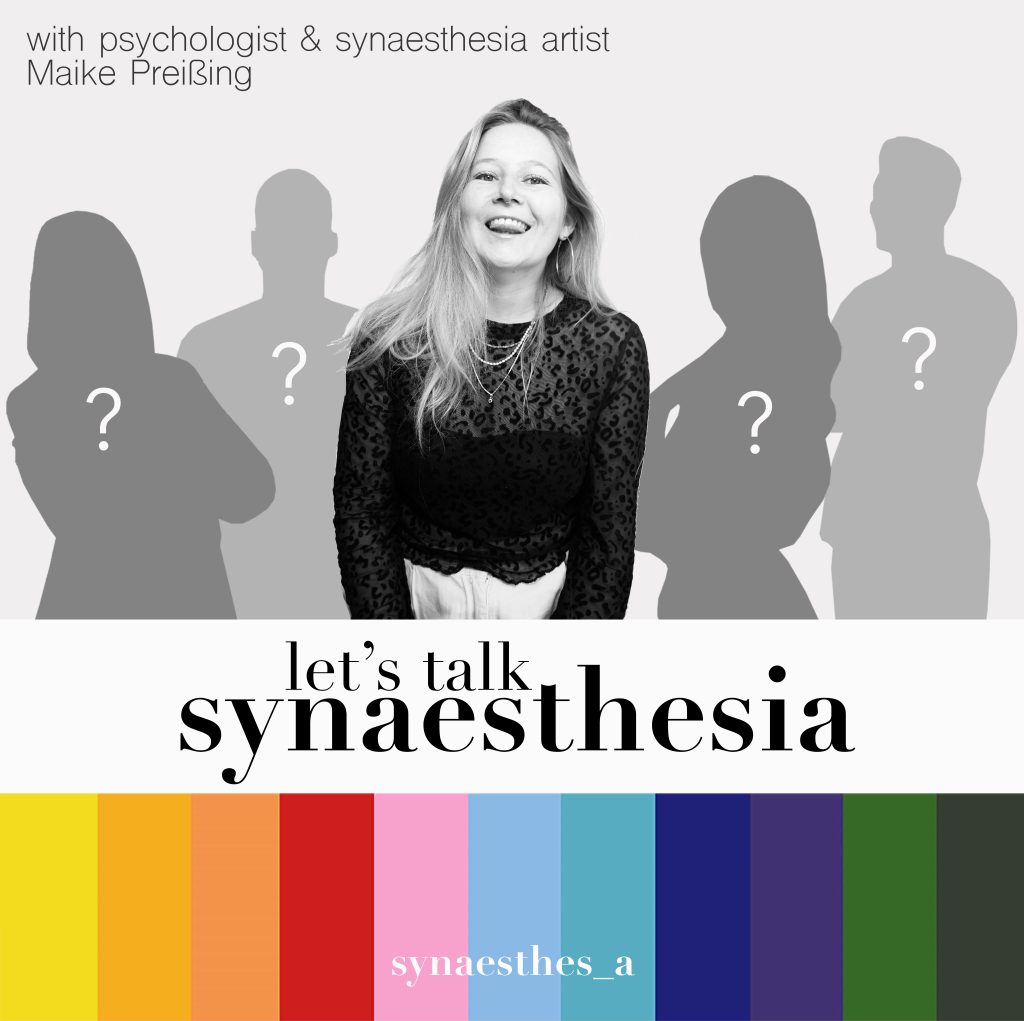
“In February 2024 the podcast celebrated its first birthday–and we were so lucky to collaborate with Journey Through the Senses to create an amazing event in Innsbruck, Austria!”– Maike Preissing, creator of the podcast, “Let’s Talk Synesthesia” |
Maike Preissing is interviewed by Patricia Lynne Duffy
PLD: Maika, (pronounced “MY-ka”) you are the creator and host of the Synesthesia
Podcast, which recently celebrated its first anniversary. What motivated you to create
such a podcast series?
MP: I experience several forms of synesthesia myself and had a difficult time explaining
this to my friends and family. I started to turn the visuals I get in my mind’s eye — when I
hear sounds, feel pain, touch or smell something — into digital art collages.
In 2020, I started to share my art on social media. It was so lovely to see people relate,
reach out ,and share their own experiences. Some of their stories were just amazing —
and I knew they needed to be shared on a platform with a wide reach. I didn’t have any
podcasting experience nor audio production skills when I decided to start “Let’s Talk
Synaesthesia”. It was a nice challenge and adventure to set this all up! We’re 35
episodes in now, and I even have a co-host now (@zoesthesia)!
PLD: Tell us about the first anniversary celebration. What are some vivid memories? I
believe the organization, Journey through the Senses (JTTS) played a supportive role in
helping to make the celebration possible. Could you tell us about that?
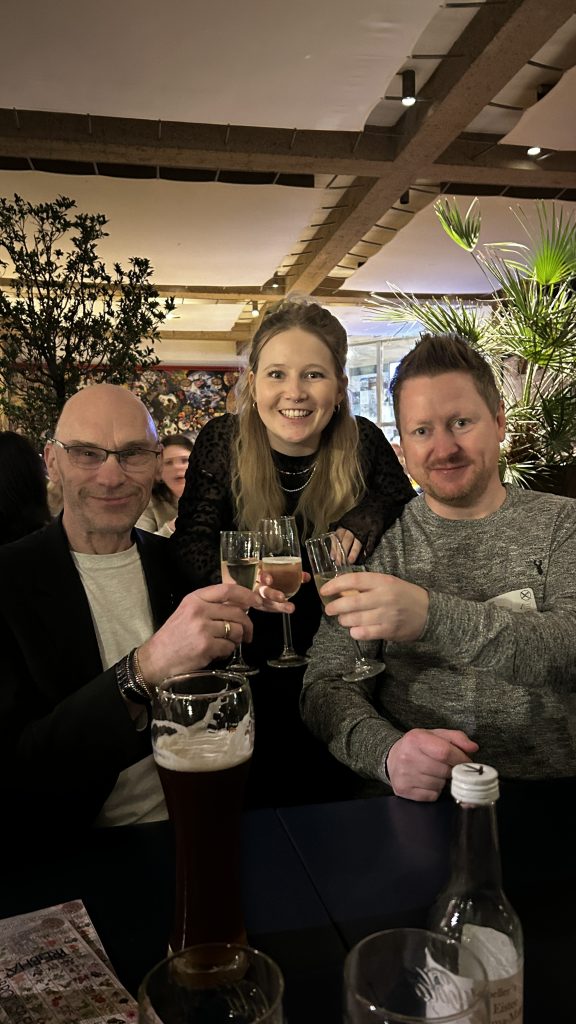
MP: In February 2024, the podcast celebrated its first birthday–and we were so lucky to
collaborate with Journey Through the Senses to create an amazing event in Innsbruck,
Austria! I had the idea to show a film or play that discusses synesthesia and other
neurodivergent conditions, as well as the misconceptions and stigma around them.
My friend Pete Carruthers’ play “The Possibility of Colour” does all of that in the most
beautiful way! For the “birthday event”, we flew both playwright Pete Carruthers and
UKSA President James Wannerton from the UK to Innsbruck, Austria. The cinema hall
was packed to watch a filmed version of the play. After, we offered goodie bags, a
really engaging panel discussion, and a dinner. All of this was possible because of the
collaboration with Journey through the Senses — and I am beyond grateful for that!
PLD: Besides synesthesia, do you experience other forms of neurodivergence?
MP: I am neurodivergent myself, yes! Neurodiversity is an umbrella term for many
conditions: Autism, ADHD, Dyslexia, Tourette’s, Dyspraxia, Synesthesia – to only name
a few. I experience synesthesia and am autistic. Synesthesia is almost three times
higher in the autistic population, so it’s interesting and necessary for me to understand
how the two traits work together and support each other.
PLD: Do you find being neurodivergent poses any challenges for you?
MP: Absolutely. Even though I love being neurodivergent and know it makes me “me”,
there are big challenges too. It took me until my mid 20s and a whole psychology
degree to get to a point where I understood my neurological disposition. I am
hypersensitive to most stimuli. I struggle with the brightness of sunlight, with heat, fabric
on my skin, sound and smells.
The world in general is very intense for me, and my body reacts by creating a
“dissociate bubble” to protect me. Unfortunately, I also experience very intense body
and joint pain after being exposed to stressful situations –for example, spending time in
very loud or overstimulating environments. Only the over the last years, I came to
understand why the world feels so surreal to me most of the time.
Today I’m much better at managing my sensory intake and know how to take
care of myself when I go overboard. But this also means that there are a lot of things I
simply cannot do because of my neurodivergence, e.g., being outside a lot in summer,
or going to big events without the right ear protection.
Even attending the recent Synaesthesia Conference at Oxford University—which
I loved—had its challenging aspects. Conferences and their related activities can
include loud, crowded events, which can be a lot for me. I have to say though, that my
synesthetic perceptions themselves are not what makes life difficult. The perceptions
add another layer for my brain to process.
PLD: What aspects of your neurodivergence pose difficulties?
MP: The difficulties stem from being sensitive and autistic. Which of course are both traits
that are significantly connected to synesthesia.
[note: Synesthesia researchers are discovering that a relatively high percentage of
those with autism experience synesthesia]. We explored this in the Oxford conference
panel on ‘Synesthesia and Autism’, which was a wonderful opportunity to shed light on
an important intersection and the misconceptions around autism.
PLD: Tell us more about the UKSA-ASA Synesthesia Association conference at Oxford
University. What was it like to be at this conference? Was it the first Synesthesia
Conference you attended?
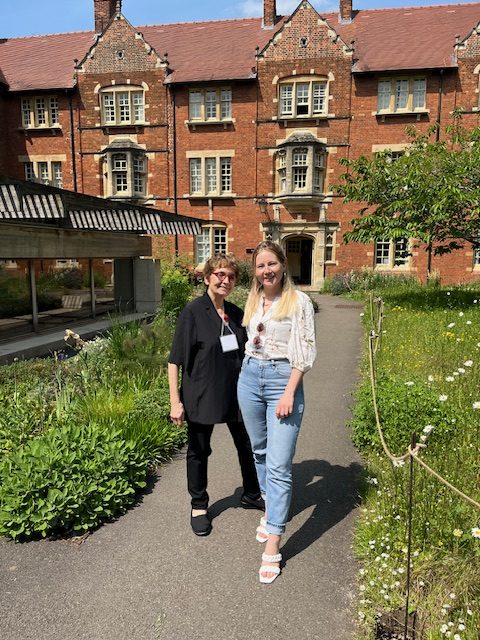
MP: It was incredible! The conference in Oxford was, in fact, the first synesthesia
conference I ever attended, and it exceeded my expectations. I met the most wonderful
people, some of whom I had already interviewed on the podcast, but met in person for
the first time.
Another highlight was staying in a holiday home with four other young
synesthetes -and watching the northern lights from our rooftop [note: the weekend of
May 10–12, the northern lights were visible in various parts of the world, including the
UK—northern lights –with their bursts of color in the darkness–are often thought to be
“symbol” of synesthetic experience].
Events and conferences can be quite overwhelming sensory-wise, so I hope that
we will be able to make the next gatherings more accessible and sustainable for the
(highly) sensitive audience this type of conference attracts.
PLD: You were recently invited to be a Board Member of the UK Synesthesia
Association, This is quite an honor! I believe you may be the youngest member this
Board has ever had. How do you feel about the invitation and involvement in the
Board’s activities?
MP: Yes, I’m super excited and feel very honored! I can’t wait to see what this new role
will bring. I hope we can create lots of new ways for people to connect, learn about
themselves and others, and educate on both synesthesia and neurodiversity in general.
PLD: Is there likely to be a future collaborative synesthesia conference?
MP: We’re slowly starting to think about the next conferences, yes. When, where and
what it will look like I don’t know yet.
PLD: Is there anything else you would like to say about the podcast, the UKSA, or any
other aspect of your involvement in the neurodiversity movement?
MP: Yes! Last year my wonderful and dedicated friend Stephen Melton took one for the
team and created the annual “Synesthesia Awareness Day”! The first one took place on
July 2 , 2023, and we can’t wait for the second one in only a few days. It’s a fantastic and
powerful way to reach people from all walks of life to educate and celebrate
synesthesia.
Access Maike Preissing’s podcast on Spotify:
Let’s Talk Synesthesia on Spotify
Patricia Lynne Duffy is the author of the now classic, Blue Cats and Chartreuse Kittens:
how synesthetes color their worlds, the first book by a synesthete about synesthesia. An
audio version of the book with research updates, music by synesthete-composers, and
an “Afterword” is recently out. Available from Audible She also contributed a chapter,
“Synesthesia and Literature” to the Oxford Handbook of Synesthesia. See her
website, bluecats.info