Raewyn Turner and Brian Harris
“Smell, like Colour, is not an intrinsic property of a molecule. Its what our cells feel when they touch it”
From the Book The Secret of Scent Adventures in Perfume and the Science of Smell (2007)) by Luca Turin
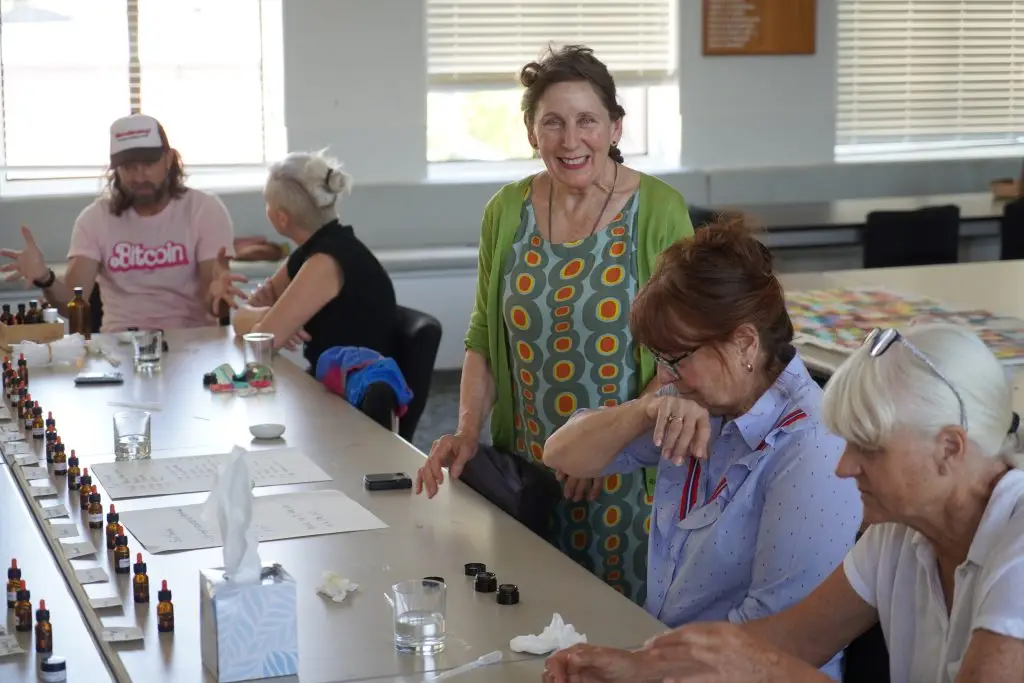
Participants were invited to a smelling experience using the creation of a rose perfume to explore the inner landscape of synaesthetic experience in colour and sound. In synaesthesia the stimulation of one sense causes an involuntary reaction in one or more of the other senses, for example seeing sound or smelling colour. The word “synaesthesia,” has its origin in the Greek roots, syn, meaning union, and aesthesis: a union of the senses. Amber is a good example of a synaesthetic equivalent in perfume: Amber isn’t made from amber stone. Its created to give a visual equivalent of the warm, golden glow of amber stone. ‘Chord ‘ in perfumery is a synaesthetic metaphor and refers to sound.
The participants were guided into sensing and colour matching perfumery materials which they mixed into a solid perfume. The resultant perfumes were played using our electronic nose turning olfactory molecules into music.
The first step in the process required priming our noses by sampling various rose mixtures including dilutions of botanical rose de mai, specialty rose bases, a commercial perfumer’s rose perfume and my own rose perfumes including a sample of the one that would be made in the workshop. I also presented one which I developed in consultation with AI.
The characteristic scent of a rose is produced by a blend of almost 300 components, none of which on its own smells like a rose. I used 16 synthetic components to create a formula which I developed through my many experiments, exploring many perfume material combinations and testing rose perfume formulas. I also consulted with a commercial perfumer who is herself a synaesthete.
I introduced the late 19th century simultaneous revolutions in both visual and olfactory synthetic materials – they were drawing from the same industrial chemical source. Synthetic perfume and synthetic color, both derived from coal tar chemistry, expanded our sensory experiences – with aniline dyes appearing in the 1850s and the first synthetic fragrance (coumarin) following in 1868. Before the 19th century, perfumes were primarily made from natural extracts of plants, flowers, and animal secretions. The development of synthetic fragrance materials in the 1860s and 1870s allowed perfumers to create and explore olfactory possibilities.
The participants commenced familiarising themselves with the 16 synthetic materials which would later be combined to make the perfume, introducing them to the evolution of the note, its form in time and the duration of perceptability,
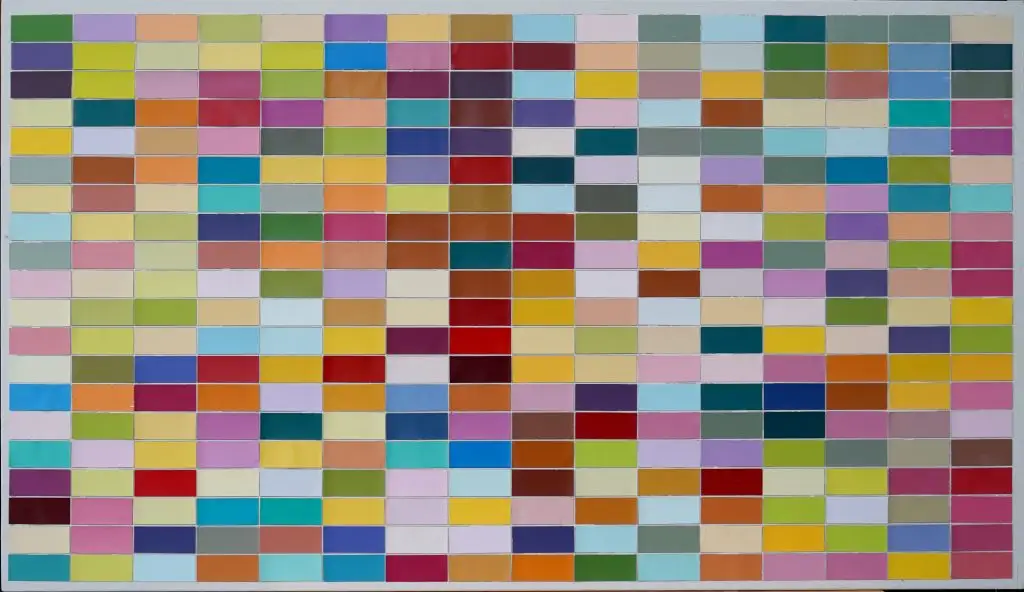
A wide array of colours was available for participants to colour match each of the 16 materials. While looking at the colours they were asked to choose which one best corresponds with or which one becomes most relevant when smelling a particular aroma chemical. Separated into sixteen columns, one for each material, their colour choices created a colour chart which indicates a collective sensing of the constituents of the rose perfume.
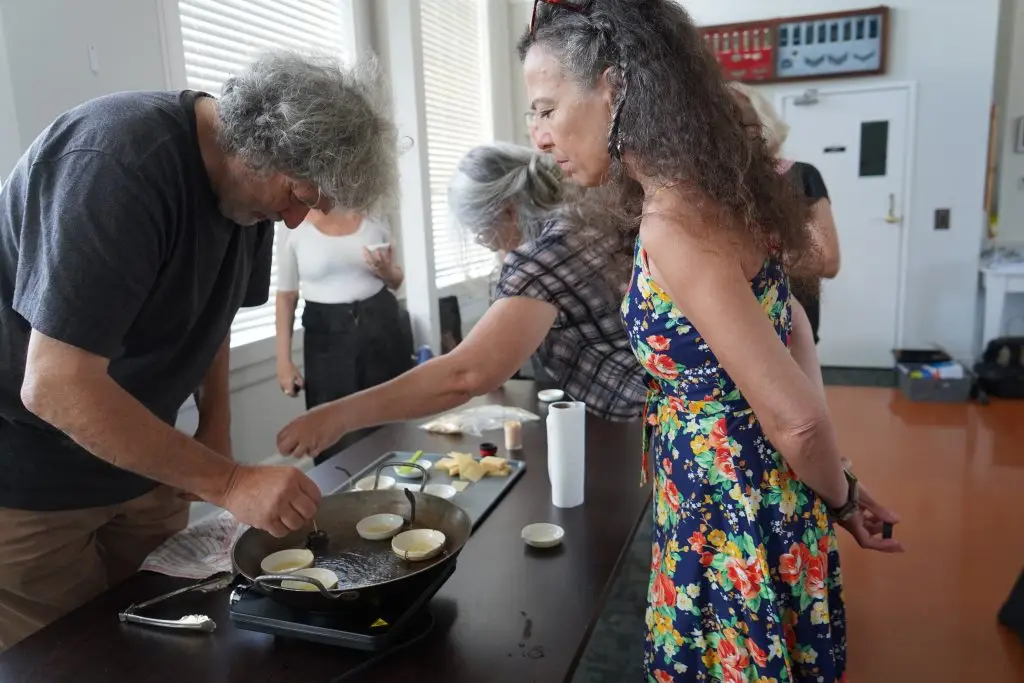
They commenced creating a solid perfume using the drops according to the formula after which they experimented with a second perfume that deviated from the formula.
Brian applied the ‘accidental piano’ to each of the perfumes and played them. The accidental piano is an electronic nose which we created inspired by the electronic noses used for both air quality as well as those used at airports to detect smell molecules from explosives. He used various catalytic bead gas sensors and a fan which draws air past them into a microprocessor for which Brian wrote code to convert tiny electrical signals into piano notes. The electronic nose conversion of olfactory molecules into audio illustrated how smell molecules can be listened to, illustrating a sensory equivalent or a digital synaesthesia.
Thankyou to Leslie Gu for filming, Jessie Brandon for her wonderful assistance, satellite2 for promoting these workshops and Journey Through the Senses who we’ve collaborated with to bring these workshops to you.
Background
As Noam Sobel says, we’re incredibly olfactory animals, constantly smelling ourselves and others.
Like other animals, plants, and insects, humans emit chemo-signals from their bodies. Social chemosignaling is implicated as a major, mostly subconscious power in human behaviour—that’s why I’m super enthusiastic about the sense of smell and exploring its unknown dimensions. As Danielle Reed says, “the way we smell and the way we smell.”
I’m not a perfumer. I’m a visual artist working with olfaction, exploring both the fragrance of humans and the perception of fragrance. As part of my work, I practice perfumery and mixing; I use the Jean Carles technique.
Background: I’ve conducted amber perfume creation workshops in Gdańsk, Poland (2019), and researched perfumes created during times of war and national trauma, in a meeting with Jean Kerléo at the Osmothèque perfume museum in Versailles. My first explorations with the sense of smell were in 1999, creating the design for the APRA Awards ceremony and two series of concerts for the deaf—Four Senses—with a symphony orchestra, translating music into smell.
I’ve worked in collaboration with Dr. Richard Newcomb on The Human Plume at Plant and Food Research NZ, with commercial perfumer Flairoma, and in an artist residency at Monell Chemical Senses, Philadelphia.
My interest is in subsensory and unconscious sensory experiences and their contribution to emotional meanings, as we negotiate a very complex geopolitical, biological, and synthetic environment. I’m interested in the power of synthetics and captive molecules to transmit remarkably profound olfactory experiences.
Brian Harris and I have been collaborating, making interactive and olfactory art since 2011. Brian’s an engineer-designer who’s working in the film industry, creating camera robotics, stabilised heads, and novel inventions. Brian creates computer-controlled and embedded devices for cameras and other special projects for the NZ and international film industry. He has a science and electronics background and has been an independent designer for 40 years, creating small- and large-scale mechatronics and bespoke equipment. His inventions for remote control, stabilised camera, and robotic trajectories have been used in local and international TV, commercial, and film productions.