| “I’ve heard from people who were bullied for being neurodivergent, or for any number of other reasons. I think just about everyone has felt weird or like a misfit at some point.–Nicola Rose. |
Nicola Rose is interviewed by Patricia Lynne Duffy
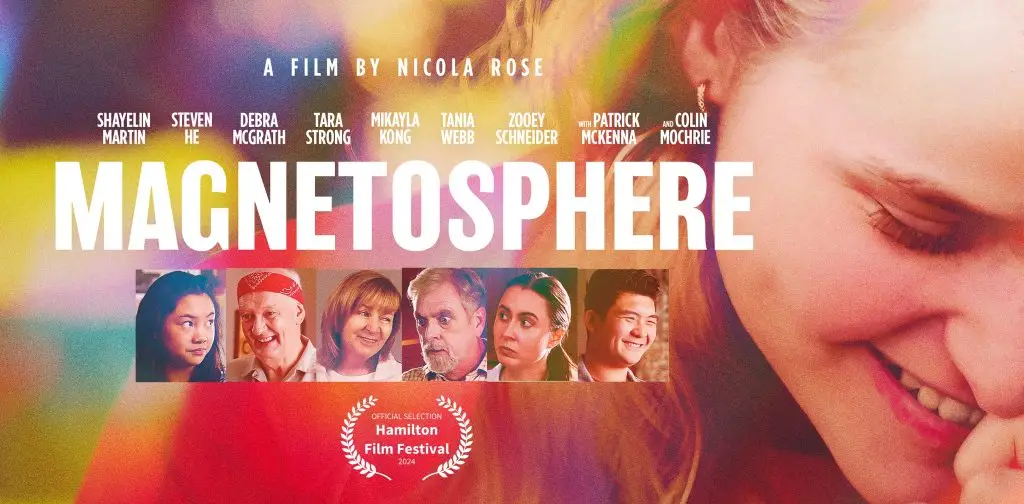
PLD: Your charming, funny film, Magnetosphere focuses on a 13-year-old girl, Maggie, who feels alone and “different”. It doesn’t help that Maggie is “the new girl” at school and is bullied by classmates.
Thanks to one of her teachers, Maggie realizes she has synesthesia—and we see how she explores and comes to terms with the unusual perception that makes her feel “weird”. Why did you decide to make a film on synesthesia?
NR: A few years ago, I saw a beautiful film about a girl with dyslexia, called Confetti by the director Ann Hu. I was intrigued by the ways neurodiversity was depicted visually. Synesthesia, or at least visual/auditory synesthesia, seemed a natural fit for cinema. I wanted to set myself the challenge of representing it onscreen. I had to do a ton of research, mainly interviewing synesthetes, in an effort to depict it as authentically as possible.
PLD: How did you create the character of “Maggie” for Magnetosphere? Was Maggie based on a person (or persons) you’ve met?
NR: The character, “Maggie” was originally the protagonist of a rather bad book I wrote when I was fifteen. There was no synesthesia anywhere to be found in the book. It was just a story about a girl growing up, as I recall. Her quirks and awkwardness from the 2003 version carried over to the 2024 version, only now she had synesthesia.
PLD: In the film, Maggie’s multiple forms of synesthesia are colorfully and vividly represented. I am thinking of Maggie’s drawing of the fishbowl—and her inclusion, not only of the bowl and fish, but also “sparkles from the water music”., as she explains to her intrigued teacher.
The film also features onscreen visuals of Maggie’s experience of colorful words and emotions. Were these depictions based on interviews you had with various synesthetes about their perceptions?
NR: Yes, I tried to stay in the realm of what the synesthetes I interviewed described, although I took some liberties with things like colors and visual details. Still, everything Maggie experiences in the film was based on someone’s reality of experiencing synesthesia.
PLD: The film also touches on other types of neurodivergence and ways people can feel socially marginalized, portraying the common struggle to find one’s place in the world.
Have you found that viewers of the film—synesthete or non-synesthete—identify with Maggie’s feeling of being “weird” and “not fitting in”?
NR: Oh yes. I’ve especially heard from people who were bullied for being neurodivergent, or for any number of other reasons. I think just about everyone has felt weird or like a misfit at some point, so that aspect of the film seems to resonate with many.
PLD: Do you, yourself, identify with being a synesthete or “neurodivergent” in any way?
NR: Yes. Through interviewing different synesthetes, I was able to access memories of having had synesthesia as a young child. I hadn’t remembered them prior. A certain piece of music, the Florida Suite by Frederick Delius, played for me in blue and green and orange (like monkey bars, or a jungle gym) when I listened to it at about five or six years old. This memory faded, then revived. I was glad to know I had my own connection to synesthesia. As far as I know, I don’t experience it now.

PLD: Magnetosphere has a few characters who provide comic relief (Maggie’s father, her teacher, and the family’s handyman). In the serious business of exploring who weare, is it also important to see the humor in our lives?
NR: It’s imperative. Life would be pretty sad and confusing otherwise. I have heard from people who’ve expressed surprise or even mild disapproval that the film is both serious and funny. In my view, Life is both serious and funny! You don’t need to pick a lane. The juxtaposition is what keeps things interesting.
PLD: Magnetosphere was shown at the Los Angeles Children’s Film Festival, the San Diego Children’s Film Festival, the Boston Children’s film Festival, and most recently, at the ReelAbilities Film Festival in New York. The ReelAbilities festival celebrates differently-abled people of all kinds. Many of the audience members were differently-abled in various ways–including but not limited to synesthesia. What was the response of this varied audience to the film?
NR: They were really rapt. There were a number of neurodivergent audience members, or those who had neurodivergent loved ones. It all goes back to feeling different from the people around you, for whatever reason that may be. There were a lot of viewers here who had had that experience and who particularly appreciated the film because of it. We also had an audience of sixth- and seventh graders (so, about Maggie’s age in the film) who were just about the most enthusiastic audience I’ve ever had. I appreciated them so much, because let’s face it, kids that age will let you know if your work is bad.
PLD: Were any of the actors in the film differently abled themselves?
NR: Yes, the renowned actor, Patrick McKenna, who plays Maggie’s dad has ADHD and has spoken out a lot on the topic. The adorable Zooey Schneider, who plays Maggie’s little sister has brittle bone disease, which she and her family have talked about publicly.
PLD: Is there anything else you would like to share about Magnetosphere?
NR: Yes! Magnetosphere will be released this summer on streaming platforms! Please follow @magnetospheremovie on Instagram and / or “Magnetosphere Movie” on Facebook for updates. And enjoy!
In Pat Duffy’s article of March 21, 2025, “Novels with Neurospicy Characters”, the piece “Appendix” was mistakenly described as a “novella”. As story-like as the work is, its author, Tyler Gore reminds us that “Appendix”, like other pieces in his book, My Life of Crime and Other Entertainments, is, in fact, non-fiction; all are drawn from his own life experiences. And by the way, let’s add here that whether fiction or non-fiction, the hilarious “Appendix” would make a great movie!https://journeythroughthesenses.org/2025/03/21/jtts-marks-neurodiversity-celebration-week/
