By Peter Colley
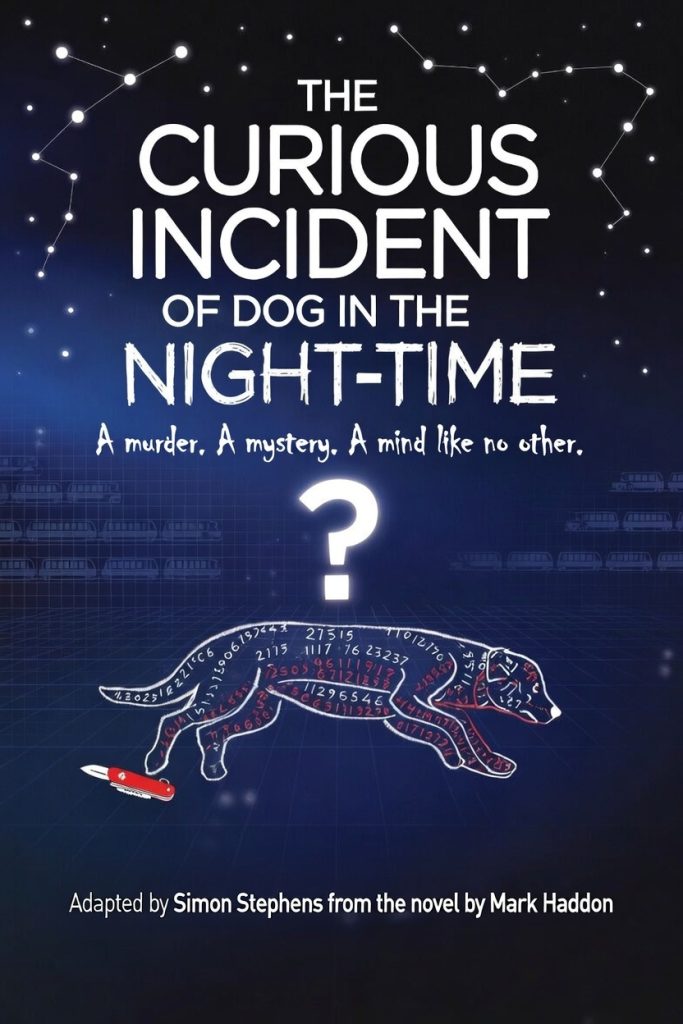
Mark Haddon’s novel “The Curious Incident of the Dog in the Night-Time” (and its subsequent stage adaptation) is a story steeped in sensory perspective. While the main character, a teenager called Christopher, is never explicitly labeled with a diagnosis in the text, he is widely recognized as being on the autism spectrum.
However, the way Christopher processes the world shares an overlapping boundary with synesthesia. Christopher’s world isn’t just about logic; it’s about a vivid, sometimes overwhelming, sensory experiences. Christopher often navigates the world through intense color coding. He decides if a day will be a “Black Day” or a “Good Day” based on the color of the cars he sees on his way to school. He also visualizes math, because to him, numbers aren’t abstract concepts – they have shapes, patterns, and physical presence. When he solves a complex equation, it’s a visual and spatial journey.
The play can go further than the novel by adding sound and light effects – Christopher’s meltdowns are portrayed as a chaotic symphony of lights and sounds – a crowded train station isn’t just “loud”, it is a physical assault of multiple simultaneous data points.
While the novel uses prose to describe Christopher’s internal logic, the stage play uses technical design elements to simulate a synesthetic experience for the audience. Using projections, the stage is designed as a mathematical grid which represents Christopher’s need for order and his spatial way of thinking. When he is overwhelmed, the theatre uses strobe lights and high-frequency sound to bombard the audience. The audience doesn’t just watch his distress; they experience cues that mimic his neurological reality.
The stage version also uses data visualization – lights on the walls display prime numbers or geometric patterns during moments of Christopher’s intense thought, turning his internal mental “images” into external visuals. In these ways, the stage can do things that a novel cannot.
Christopher’s struggle is an abundance of sensory input that he must meticulously categorize to survive. To mimic the physical pain Christopher feels in loud environments, the stage production uses sudden, sharp “stings” – loud, dissonant electronic chords that hit the audience at the same time a bright light flashes.
When Christopher is overstimulated, the stage is often washed in a sterile, blindingly bright white light. This removes all shadows and depth, making the world feel flat, harsh, and inescapable. He tells us he hates yellow and brown, but loves red. The lighting often reflects this; red cues feel safe and structured, while yellow lighting is used to denote areas of high anxiety or “danger” in his mind.
So while the play is not about synesthesia, it contains elements that synesthetes should recognize.