Multisensory design is essential for the configuration of products for daily life, complex technical operations, and living environments. It implies the inclusion of all senses which are involved in the use of a specific product into the design process. All modalities need to contribute to the product perception in a functional and pleasant manner. However, it is not sufficient to optimize the perceived features separately for all senses. Appropriate alignment and harmonization of those features with respect to the interaction of the senses cannot be omitted.
Somewhat surprisingly from a traditional approach on perception, reports and research on synesthesia have proven that the senses are already active even in cases wherein a modality is not triggered by external stimulation. In this manner, sounds can have colour, and smells are shaped. Such processes are self-evident in the minds of synesthetes, but there are many cases in which similar processes are common for all individuals. As an example, a piece of music may translate in the imagination to a visual configuration. It is thus evident that the multisensory design process must essentially be extended to a full synesthetic design, focused on all modalities, whether instantaneously stimulated or not.
Initially, the principles and methodologies of multisensory design need to be based on multisensory thinking. In modern product design, simple forms play an essential role. This applies to all of the senses. It is certainly not by chance that simple forms are also prevalent in synesthetic perception. The challenge of composition of complex configurations includes the task of meaningful combinations and clustering of such simple elements. All elements must be allocated to either the foreground or background of a Gestalt configuration. This requires precise adjustments of the perceived intensity of all stimuli, and the elimination of distracting influences.
Targeted product design thus depends on both scientific results and additional perceptual evaluations with test persons. Moreover, it may significantly be supported by physical measurements.
I will provide insights into the topic of multisensory and synesthetic design, perceptual evaluation, and technical assistance in regular intervals.
Links:
https://www.researchgate.net/profile/Michael-Haverkamp/research
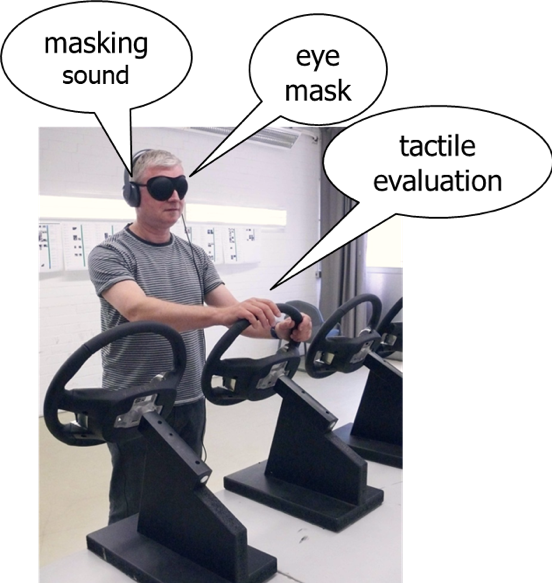
Multi-sensory evaluations at Ford Werke GmbH with various steps to intentionally include and exclude specific senses (2014).
Assessment of perceived quality of steering wheel material as perceived through various senses, with particular attention to cross-sensory interactions.
The image exemplifies an evaluation focused on tactile sensation.
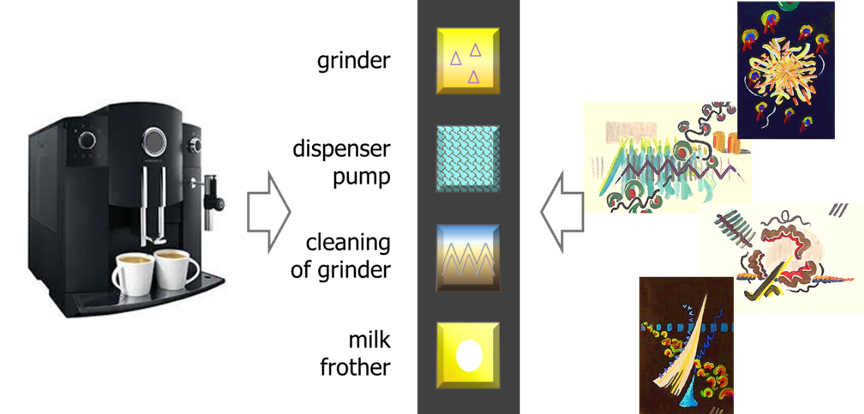
Proposal of visual feedback for a coffee-dispenser according to functional sounds. Design of indicator lamps derived from synesthetic sound images (M. Haverkamp).
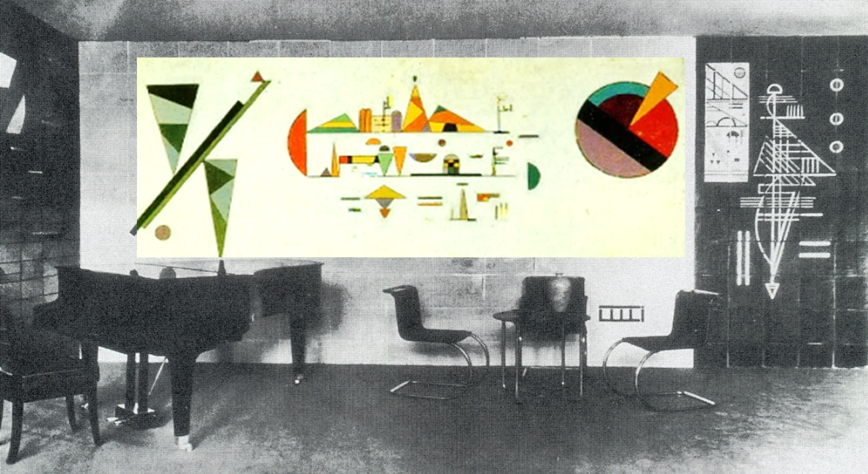
Multisensory design in architecture: Basic forms and colors correspondig to music. Ceramic mural for a music room by Wassily Kandinsky presented at Deutsche Bau-Ausstellung Berlin, 1931; Architecture by Mies van der Rohe.
Kandinsky‘s colored draft (Bauhaus Archiv Berlin) is here inserted into the historic photo.
Dr. Michael Haverkamp Bahnwärterweg 76 50733 Köln 0221-2615990 michael.haverkamp@netcologne.de
|